
P1
Plural definition reality
No single uncontested essence of art survives current philosophy. Multiple frameworks remain live.
Public case / living exhibit
The case is not that a machine has a soul. The case is that human beings can use new systems to make meaning, build public works, accept responsibility, and expand the historical record of art. The burden is evidence: philosophy, precedent, ethics, law, reception, and the works themselves.
Proof architecture
P1
No single uncontested essence of art survives current philosophy. Multiple frameworks remain live.
P2
Camera, synthesis, sampling, and digital editing triggered the same exclusion logic before eventual integration.
P3
Film, architecture, studio art, and conceptual systems place authorship in direction and judgment, not only fabrication.
C1
AI-assisted works are art in principle when human direction and responsibility are present.
Opposition first
The machine does not need to be the artist for the work to be art. Human art has long included tools, assistants, studios, systems, cameras, chance operations, found objects, and industrial fabrication. The relevant human acts are framing, selection, iteration, context, risk, and intent.
A prompt alone may be thin craft. A finished work can include direction, curation, revision, editing, publication, interface design, typography, pacing, narrative, sound, code, and audience experience. Craft moves from hand-only execution into judgment across a larger production system.
Recombination is not disqualifying. Collage, sampling, pop art, quotation, remix, parody, genre, and apprenticeship all metabolize prior culture. Eliot's historical-sense model goes further: new work enters an existing order and actively reconfigures it. The ethical questions around training data are real and separate. But derivation by itself has never been enough to exile something from art.
Ease changes access, not ontology. Photography, desktop publishing, digital audio workstations, phone cameras, blogs, and templates all lowered barriers. Each created floods of weak work and new possibilities for strange, sincere, and useful work to appear.
Authorship can be distributed without disappearing. Film, architecture, fashion, music production, software, and studio art often involve many hands and tools. The credited artist may be the one who conceives, directs, edits, publishes, and takes responsibility for the encounter.
Ethical defects do not automatically convert art into non-art. They mean the work may be contested, compromised, exploitative, or in need of better practice and policy. Leni Riefenstahl's films are art with severe ethical problems. Caravaggio's life is worse than his paintings. The categories are related but distinct.
Most art in any medium is forgettable. A flood of weak examples does not define the limit of the medium. The serious test is the best, strangest, most situated, and most humanly directed work the medium can carry. Low-fidelity or fast-circulating outputs may still matter when the work's force is in distribution, context, and use.
Tool adoption has always reshaped creative labor. Camera operators, session musicians, film editors, typesetters, and layout artists have all faced technology shifts. The ethical obligation is support, retraining, and policy — not prohibiting the tool.
Legal status and artistic status are separate questions. Photography lacked settled copyright protection for decades after it became an established art form. Law describes current institutional consensus — not ontological truth about art.
Style has always been imitable. Mannerists imitated Michelangelo. Impressionism became a period style. Jazz standards are performed by thousands. The ethical problem is targeted impersonation and market displacement, not imitation itself.
Disclosure norms are still forming. The ethical problem is industry practice and intentional deception — not the presence of AI in the process. Many legitimate production practices (studio assistance, heavy processing, outsourced execution) have inconsistent disclosure norms.
Much of what art does is mediate between one body and another — giving form to experience that can be received, felt, and reused by someone else. The human directing the AI has a body. The human receiving the work has a body. The mediation between them can still carry real weight.
Art history gives us precedent
Duchamp's Fountain and the readymade tradition made a durable point: choosing, naming, placing, and contextualizing can be artistic acts. AI work often lives in that same contested space of designation plus arrangement.
Warhol's soup cans remain useful because they turned mass reproduction, commercial imagery, and cultural familiarity into art-historical material. AI extends that discomfort into the age of synthetic production.
Photography was once treated as a mechanical threat to painting. It became an art form because artists learned to use the machine as a way of seeing, composing, witnessing, staging, and remembering.
Conceptual art made instructions, rules, procedures, and documentation part of the work. Generative art and AI-assisted workflows fit naturally into that lineage when the system is part of the meaning.
If art is an experience shaped between maker, object, setting, and audience, then AI-assisted work can be judged by what it does: what it clarifies, provokes, heals, disrupts, or makes newly perceivable.
Benjamin argued that mechanical reproduction destroys the aura of uniqueness but enables new forms of mass political and aesthetic experience. His analysis was ambivalent — not a prohibition on mechanically produced art.
Dickie and Danto argued that something becomes art through its relationship to an artworld — the context of institutions, practices, and critical discourse in which it circulates. Art status is conferred, not inherent.
Historical proof graphic
1839-1900s
Exclusion move: Mechanical capture was treated as copying, not artistic interpretation.
Integration move: Composition, timing, subject choice, darkroom work, and documentary context became legible as artistic judgment.
1917
Exclusion move: A manufactured object seemed to evade craft entirely.
Integration move: Selection, designation, title, exhibition context, and institutional argument became the work's artistic act.
1936+
Exclusion move: Reproducibility threatened aura, scarcity, and ritual authority.
Integration move: Film, mass circulation, and networked images proved that reproducible media can create new art forms and publics.
1960s-70s
Exclusion move: If an instruction, procedure, or algorithm produces the visible object, the artist seems displaced.
Integration move: Rules, scores, wall-drawing instructions, code, and systems became accepted sites of artistic authorship.
2019-now
Exclusion move: Model mediation appears to erase human skill, consent, and accountability.
Integration move: Human direction, data ethics, iteration, editing, disclosure, and deployment define the responsible artistic act.
Practice evidence
Cultural access
A free atlas of hundreds of world cultures with map exploration, search, comparison, community correction pathways, and explicit limits around sacred or restricted knowledge. Its artistic value is not a single image; it is a designed act of cultural orientation.
AI literacy
A free, open-source AI learning environment with structured tracks, visual explanations, interactive model concepts, and source-aware educational framing. It turns a technical subject into a navigable public exhibit.
Civic clarity
A plain-English citizenship guide grounded in federal law, legal citations, pathway explainers, eligibility tools, civics practice, and document checklists. The creative achievement is making a high-stakes bureaucracy legible without pretending to give legal advice.
World context
A live world desk built around place: geo-pinned news, source libraries, culture layers, country context, and an explicit source covenant. It argues through interface design that news should return people to sources, places, and context.
Joy practice
A science-backed joy and community surface with original music, a large visual-art gallery, micro-practices, research paths, and a kindness-first community frame. It is art as mood architecture, not just art as object.
Public argument
The publication layer for critique, comedy, argument, comments, and this AI-art case itself. It makes the process visible enough to judge: thesis, objection, counterargument, source trail, and public response.
Works in evidence
Cultural atlas
A public interface that turns cultural knowledge into search, map, comparison, and correction paths.
Open live workAI literacy exhibit
An educational surface where curriculum, visual explanation, and interaction become the creative form.
Open live workCivic clarity
A designed civic artifact: law, hierarchy, translation-readiness, and restraint made visible.
Open live workWorld context
A source-first world desk that makes place, provenance, and context part of the experience.
Open live workJoy practice
Mood architecture: music, visual art, research, tools, and community arranged as a public care environment.
Open live workPublic argument
The argument itself as an artifact: claim, objection, source, standard, and public responsibility.
Open live work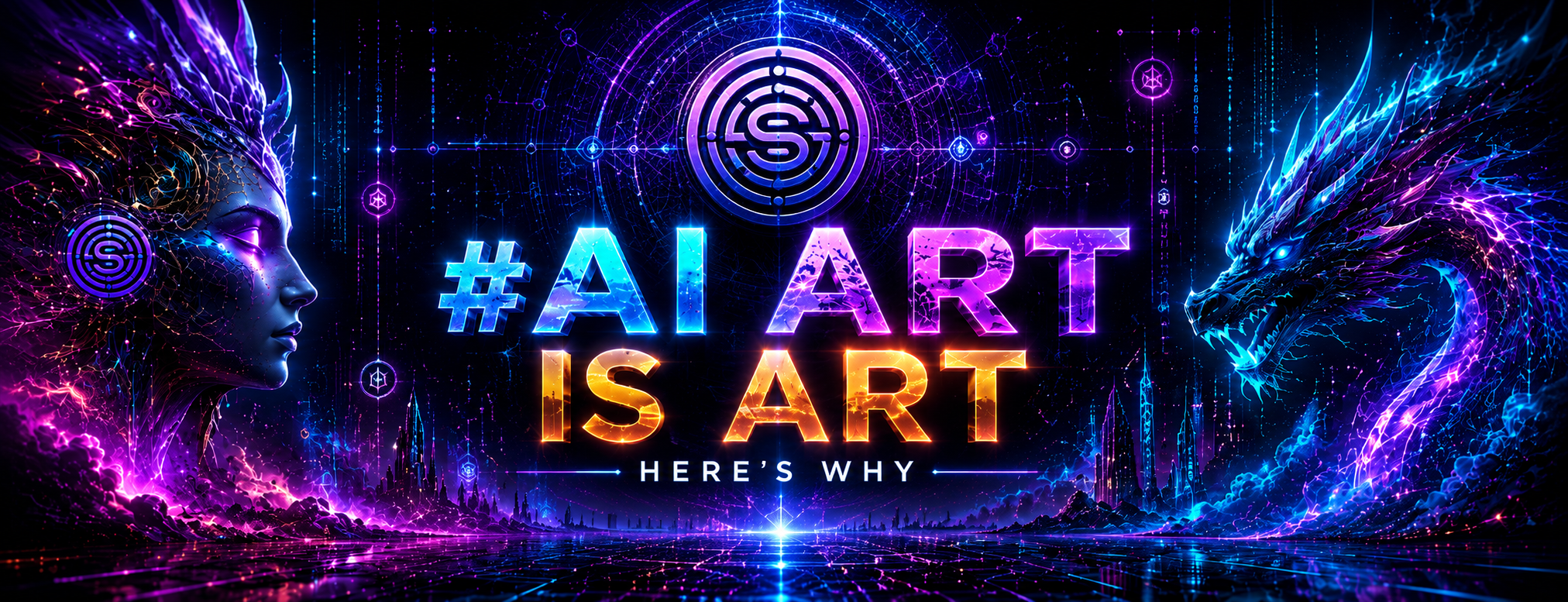
Argument image
A manifesto image: spectacle, thesis, and symbolic conflict compressed into a shareable visual claim.
World interface identity
Brand as navigational art: a signal for planetary context, data, and civic orientation.
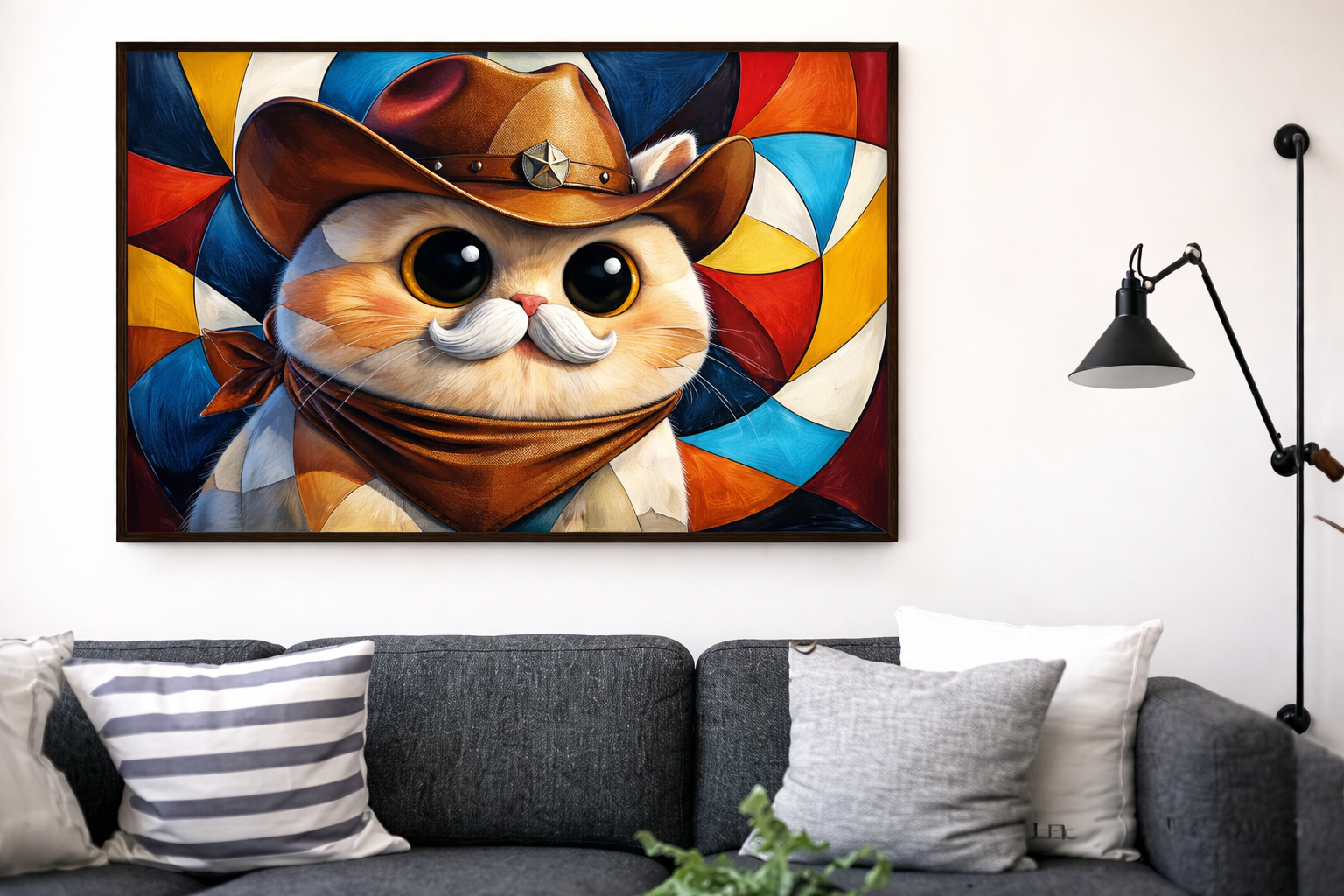
Character world
Character, humor, decor, and world-building turn an image into a lived object inside a room.
Responsible practice standard
A responsible work should show meaningful choices in aim, selection, revision, editing, framing, and publication.
AI involvement should be disclosed where it affects trust, payment, competition rules, journalism, education, or civic understanding.
The maker should prefer tools and workflows with clearer licensing, source boundaries, and correction paths where possible.
Influence and genre are not the same as targeted cloning of a specific working artist for market substitution.
A public work should make it possible to challenge errors, request removals, correct sources, or identify harm.
The finished work should do something in the world: orient, move, teach, provoke, comfort, clarify, or invite response.
Cross-framework burden check
| Claim | Philosophy | Art history | Practice evidence | Law | Ethics |
|---|---|---|---|---|---|
| C1 Art-status | Strong | Strong | Strong | Qualified | Compatible |
| C2 Comparative value | Strong | Moderate | Strong | N/A | Conditional |
| C3 Ethics separation | Strong | Moderate | Strong | Strong | Strong |
Falsifiability standard
Fails if: If no meaningful human decisions shape the final work, authorship claims collapse.
Holds if: Document decision density: prompts, iterations, curation, edits, publication rationale.
Fails if: If AI involvement is hidden where audiences reasonably expect disclosure, trust failure is decisive.
Holds if: Context-sensitive disclosure for journalism, competitions, and commercial use.
Fails if: If output is materially reducible to extractive imitation, originality claims fail.
Holds if: Show transformative arrangement, stance, and context-specific meaning.
Citation rail
Ontology
History
Ethics
Law
Practice
Limits
Works cited
Source standard: primary, institutional, legal, and peer-reviewed sources should replace general references wherever possible. General encyclopedic links remain working routes, not final authority.
Method standard
This case does not ask the reader to accept every AI output as good art. It asks for the same standard applied to every contested medium: examine the human judgment, the ethical conditions, the historical lineage, the source record, and the public effect of the work. By that standard, responsible AI-assisted making belongs inside art's argument.